
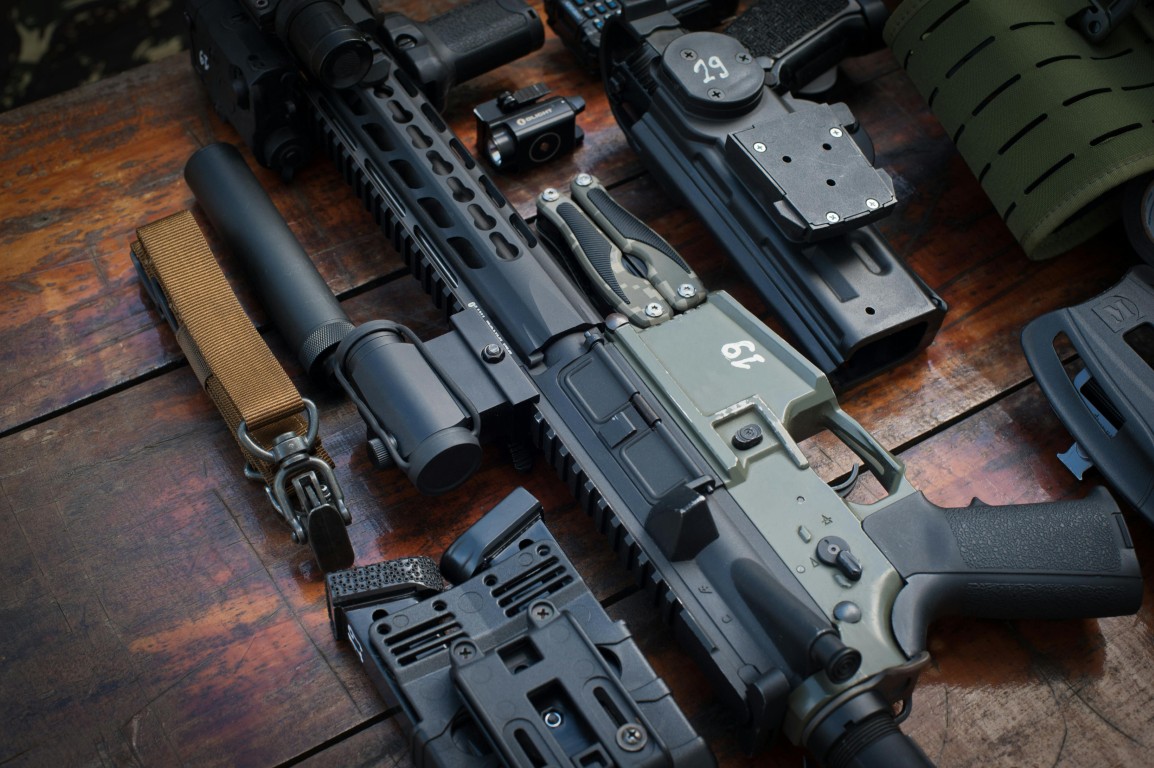
Once you notice the word “marksman,” you start seeing it everywhere. It appears on rifle listings, scope boxes, slings, cases, bipods, and enough accessories to make you wonder whether the entire outdoor industry recently discovered the same thesaurus.
Apparently, everything is a marksman product now. Three-hundred-dollar rifles and five-figure precision platforms are both sold under the same language, which is a little like calling every car with a spoiler a race car.
I do not believe in coincidences, especially profitable ones. Somewhere along the line, somebody realized that the word “marksman” could make an ordinary product sound precise, serious, and vaguely military without requiring anyone to prove that the label actually meant anything.
So I started digging. The annoying part is that the term is legitimate, which makes the abuse of it much easier to hide.
Where Marksman Rifles Actually Came From
A marksman rifle is not just a rifle with black furniture and a serious-looking optic. The term comes from the designated marksman role used by military units to extend the accurate reach of an infantry squad beyond what is normally expected from standard service rifles.
The designated marksman generally operates at intermediate distances, often somewhere around 300 to 600 meters. That puts the role beyond ordinary close-range rifle work but well short of the extreme distances usually associated with dedicated sniper systems.
Because of that role, true designated marksman rifles tend to emphasize accuracy without giving up speed. Semi-automatic platforms are common because the shooter still needs rapid follow-up capability, while magnified optics and cartridges such as 7.62 NATO give the rifle additional reach and precision.
That is the real definition. It is a specialized rifle built around a specific job, not a decorative word manufacturers can sprinkle over whatever happens to be sitting in the catalog.
Naturally, that distinction gets considerably murkier once marketing departments enter the room. The farther the term travels from its original context, the less anyone seems interested in what it was supposed to describe.
How Three Different Rifle Categories Got Blurred Together
Marksman rifles, sniper rifles, and hunting rifles can all be extremely accurate. That does not make them the same thing, because each category is built around a different set of priorities.
Marksman rifles are generally designed for intermediate-range precision with quick follow-up shots. Sniper rifles place greater emphasis on maximum precision and consistency at longer distances, which is why bolt-action designs remain common in that category.
Hunting rifles have another set of priorities entirely. Accuracy matters, of course, but so do weight, handling, reliability in the field, and the practical realities of carrying the rifle for hours before taking a carefully selected shot.

None of these categories is inherently better than the others. The problem begins when the terminology from one gets pasted onto another because “marksman” or “sniper” sounds more impressive on a product page than simply describing what the rifle was actually designed to do.
That is how the fog sets in. A perfectly competent hunting rifle suddenly becomes “marksman inspired” after a stock change, while a general-purpose semi-automatic platform earns a precision label because somebody bolted glass to the top rail.
The Labeling Scheme Is Almost Too Easy
My theory is simple. Take an ordinary rifle, give it a black finish, add an adjustable stock, photograph it against a dark background, and then put the word “marksman” somewhere near the product name.
There is no universal authority waiting to certify the claim. No independent board requires a particular group size, barrel specification, trigger standard, or competition record before a manufacturer gets to use the term.
The word itself therefore ends up doing most of the work. Buyers associate it with precision and professional use, while the manufacturer gets the benefit of that association without necessarily changing anything meaningful about the rifle underneath.
Some rifles wearing the label are genuinely excellent precision platforms. That is what makes the trick effective, because the legitimate examples lend credibility to everything else using the same vocabulary.
A buyer who does not know what to inspect sees the same language applied across the market and assumes the products belong in the same class. The people writing those descriptions are not exactly rushing to correct the misunderstanding.
The Things Marketing Cannot Fake
If the label cannot be trusted, the obvious solution is to ignore it and start looking at things that can actually be measured. Barrel quality, chamber consistency, how the barrel is fitted, trigger feel, repeatability, and verified accuracy tell you more than the adjective printed on the box ever will.
Accuracy claims deserve scrutiny too. A manufacturer saying a rifle is “sub-MOA capable” means much less if it never explains the ammunition, shooting conditions, number of shots in the group, or whether the result represents an average or a single unusually good target.
Build quality is equally difficult to hide once you know what to examine. Consistent machining, solid bedding, predictable controls, and components that stay tight through repeated use reveal far more than a tactical-looking stock or another piece of rail space.

My favorite test, however, is competition. Precision rifle matches are wonderfully indifferent to marketing departments because a scorecard does not care what somebody called the product in a brochure.
Shooters competing seriously tend to abandon equipment that will not hold zero, run consistently, or produce repeatable groups under match conditions. That is why the best competition rifle is a much more useful reference point than whatever happens to be wearing the fashionable label of the month.
Why Competition Cuts Through The Nonsense
Competition exposes weaknesses that a product photograph cannot. A rifle has to perform stage after stage, and the shooter has to be able to trust that the mechanical system will behave the same way each time.
That pressure produces a much cleaner kind of reputation. Equipment that works keeps appearing on firing lines, while equipment that fails tends to disappear regardless of how aggressive the advertising campaign was.
This is where companies like CheyTac become interesting. The useful question is not whether a rifle can be dressed up with enough terminology to sound precise, but whether the engineering, manufacturing, and real-world performance justify the reputation.
CheyTac has built its name around precision-oriented rifle systems rather than treating accuracy as an accessory package. For shooters evaluating serious precision equipment, that makes specifications, consistency, and demonstrated performance a much better place to start than whatever category name happens to be fashionable.
You do not have to accept every claim uncritically. In fact, you should not. The entire point is to look past the language and examine what the rifle actually does.
Labels Are Cheap
Marksman rifles are real. The designated marksman role is real, the rifles built around it are real, and some of those platforms are exceptionally capable pieces of engineering.
The conspiracy, if we are going to call it that, is not the existence of the term. It is the way a useful technical description became a marketing costume that can be draped over products that never earned the association.
So use the same rule that applies everywhere else in modern life. Ignore the name on the box long enough to look at the barrel, trigger, construction, accuracy data, and the equipment serious competitors actually trust.
If you are evaluating precision rifles, take a closer look at CheyTac’s lineup and judge it by the things that can be measured. Labels are cheap. Groups on paper are not.
CheyTac USA
+17315356029
24070 US-70, Huntingdon, TN 38344
